Melbourne roof maintenance calendar: what each month does to your roof
What Melbourne's weather does to your roof in every month of the year, built on Bureau of Meteorology data, with the checks to do each season and the best months to book repairs or a restoration.
:focal(720x150:1000x430))
)
Quick answer: Melbourne's roof year has four seasons of risk. Summer brings heat, UV of 9 to 10 and storms. Autumn is the easiest time for roof work, until leaves fill the gutters. Winter is damp (83% humidity on June mornings), so leaks and mould show up. Spring brings the strongest winds and, at Melbourne Airport, the wettest months. Coat or restore between October and April.
I've spent more than 20 years on Melbourne roofs, and what goes wrong on them follows the weather. The weather, in turn, follows a pattern you can plan around.
So I've put that pattern on paper. The numbers come from the Bureau of Meteorology's long-term averages for Melbourne Airport, which has records back to 1970, with the city station at Olympic Park alongside. The roof notes come from what I see on the job.
Use it as a calendar: what to check each month from the ground, and when to book the bigger jobs so they're done before the weather turns.
Melbourne’s roof year at a glance
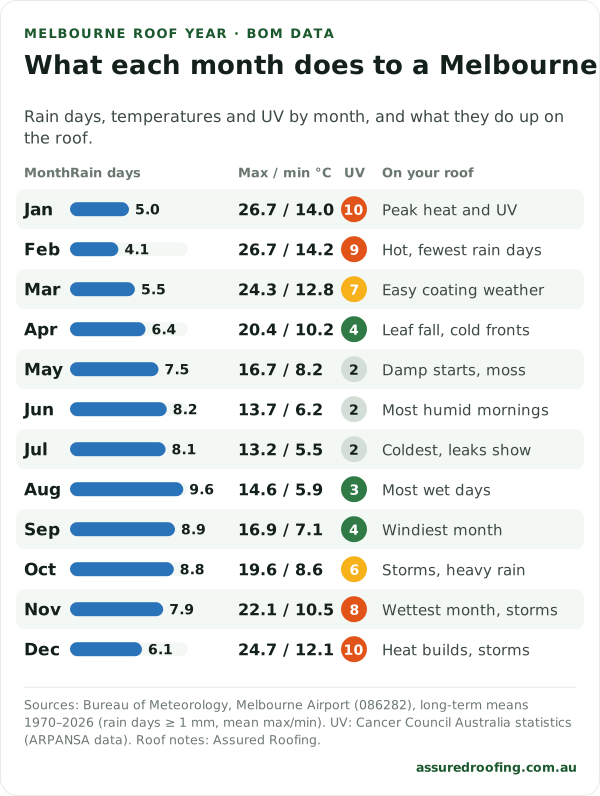
What each month does to a Melbourne roof, from Bureau of Meteorology averages for Melbourne Airport. The same figures, plus the job for each month, are in the table below.
Month | Rain (mm) | Rain days | Avg max / min °C | UV | Main roof risk | Your job this month |
|---|---|---|---|---|---|---|
January | 42.4 | 5.0 | 26.7 / 14.0 | 10 | Peak heat and UV | Check the roof space on a hot afternoon |
February | 38.6 | 4.1 | 26.7 / 14.2 | 9 | Heat, fewest rain days | Book coating work for early starts |
March | 36.9 | 5.5 | 24.3 / 12.8 | 7 | Easy coating weather | Book a restoration before winter |
April | 45.3 | 6.4 | 20.4 / 10.2 | 4 | Leaf fall, cold fronts | Clear gutters and valleys once leaves drop |
May | 39.7 | 7.5 | 16.7 / 8.2 | 2 | Damp starts, moss grows | Second gutter check; look for moss |
June | 39.7 | 8.2 | 13.7 / 6.2 | 2 | Most humid mornings | Look for damp or mould on ceilings |
July | 35.0 | 8.1 | 13.2 / 5.5 | 2 | Coldest month, leaks show | After heavy rain, look for new stains |
August | 43.6 | 9.6 | 14.6 / 5.9 | 3 | Most rain days | Book repairs before spring |
September | 45.2 | 8.9 | 16.9 / 7.1 | 4 | Windiest month | Check ridge lines after windy days |
October | 55.7 | 8.8 | 19.6 / 8.6 | 6 | Storm season, heavy rain | Pre-storm check; trim overhanging branches |
November | 62.4 | 7.9 | 22.1 / 10.5 | 8 | Wettest month, storms | Clear gutters before the heaviest rain |
December | 51.0 | 6.1 | 24.7 / 12.1 | 10 | Heat builds, storms | Check roof space ventilation before the heat |
Melbourne Airport averages, 1970 to 2026 (BOM). Rain days are days with at least 1 mm. UV is the average daily maximum (Cancer Council Australia, ARPANSA data).
Summer (December to February): 8.4 of the year’s 10 days at 35 °C or hotter
At Melbourne Airport, December to February average 8.4 of the year's 10 days at 35 °C or hotter, and the UV index averages 9 to 10 (Cancer Council Australia, using ARPANSA data).
That's the combination that ages a roof fastest. Coatings chalk and fade, sealants harden, and heat builds up in the roof space and radiates down into the house.
December: heat builds and storms are common
December averages 51.0 mm of rain on 6.1 days at the Airport, with 1.9 days at 35 °C or hotter. Summer storms can drop a lot of that rain at once, which is when a blocked gutter or a cracked ridge shows itself.
DIY check on a hot afternoon, put your head up through the manhole. If the roof space is stifling, ventilation may help; I've written up whether whirlybirds work.
January: the hottest month, with UV 10
January averages 26.7 °C by day, with 8.8 days at 30 °C or hotter and 3.8 at 35 °C or hotter (BOM, Melbourne Airport). A roof in full sun runs far hotter than the air around it.
If your roof is dark, it soaks up more of that heat. A lighter colour or a heat-reflective coating reflects more of it, and I've looked at whether heat-reflective roof paint is worth it in Melbourne.
Good to know on the bush fringe, the CFA's Fire Danger Period may be in force. The CFA's property preparation guide says to keep gutters clear of leaf litter and seal roof gaps, because embers start fires in roof gaps.
February: the fewest rain days (4.1 at the Airport)
February has the fewest rain days of the year: 4.1 at the Airport and 3.5 in the city. It's still hot, with 2.7 days at 35 °C or hotter.
Dry weather is good for coating work, but a sunlit roof can pass the upper surface limit in coating data sheets (35 to 40 °C), so we start early in the day.
Storms still come through. The Valentine's Day storms of February 2024 brought down trees and power lines and left more than half a million homes without power. The Insurance Council of Australia puts the claims at about 27,800, worth $237 million. For storm damage to the roof itself, here's what hail does to a Melbourne roof.
Autumn (March to May): the easiest months for roof work, then leaf fall
March: 24.3 °C days, 12.8 °C nights and 70% humidity
March is the easiest month of the year for coating work. At the Airport it averages 24.3 °C by day, 12.8 °C overnight and 70% humidity at 9am, comfortably inside the limits in roof membrane data sheets.
If you want a roof restoration finished before winter, book it in February or March. We're usually booked about a month ahead, and a full restoration takes 4 to 5 days on site. Here's what a restoration costs in Melbourne.
April: leaf fall fills gutters and valleys
April averages 45.3 mm at the Airport. In the city it's the wettest month of Olympic Park's short record, at 66.7 mm (2013 to 2026).
It's also when deciduous trees drop their leaves into gutters and valleys, right before the damp months.
The fix clear the gutters and valleys once the leaves are down, not before. See how often to clean gutters in Melbourne, or have us check the guttering.
May: damp mornings (79% humidity) and moss wakes up
By May, 9am humidity averages 79%, nights average 8.2 °C and the UV index drops to 2. Rain days climb to 7.5 a month.
Moss and lichen get going on the shaded south faces, and coating work becomes weather-dependent. It's a shoulder month. Here's how to clean roof tiles safely.
Winter (June to August): Melbourne’s dampest months, with 8.1 to 9.6 rain days a month
June: the dampest mornings of the year (83% humidity at 9am)
June has the highest average 9am humidity of the year at the Airport, 83%, with overnight lows of 6.2 °C and 2.0 nights at 2 °C or colder.
Cold roof timbers and damp air are how condensation forms in a roof space. It can look a lot like a leak, and both lead to mould.
DIY check look at ceilings in corners, wardrobes and above bathrooms for grey or brown marks. A stain that grows after rain is usually a leak; see how to fix a leaking roof.
July: the coldest month (13.2 °C days, 5.5 °C nights)
July averages 13.2 °C by day and 5.5 °C overnight, with 2.9 nights at 2 °C or colder, the most of any month at the Airport.
Slow leaks show up now, because the roof stays wet for days. The usual culprits are cracked ridge pointing and rusted valleys, like the one behind this leaking Doncaster ceiling.
Urgency a leak in winter doesn't dry out between showers. Wet timber and insulation rot and grow mould, so get it looked at early.
August: the most rain days of the year (9.6)
August has the most rain days of any month at the Airport, 9.6, and in the city, 9.3. The wind picks up too, to an average 23.9 km/h at 3pm.
It's the month to book spring repairs. UV climbs back to 3 by mid-August, and the good coating weather returns from October.
Spring (September to November): the windiest month, then the wettest
September: the windiest month (24.4 km/h at 3pm)
September has the strongest average wind of the year at Melbourne Airport, 24.4 km/h at 3pm. Loose ridge caps and slipped tiles move now, and VICSES warns that roof tiles can become flying debris in strong winds.
After a storm walk around the house and look along the ridge lines and roof edges with binoculars. Look for tiles out of line, gaps in the mortar and bits of cement in the gutters.
October: storm season is under way
The Bureau of Meteorology says most thunderstorms form between September and March, although severe storms can happen at any time of year. VICSES calls spring and summer Victoria's high-risk season for severe thunderstorms, damaging winds and flash flooding.
October averages 55.7 mm on 8.8 days at the Airport and 64.2 mm in the city. In some outer councils the CFA's Fire Danger Period can start this month.
DIY check before storm season, VICSES suggests trimming trees back from the house and clearing gutters, downpipes and drains. I'd add one more: take a few photos of your roof from the ground each spring, so you have a before picture if a storm does damage.
November: the wettest month at Melbourne Airport (62.4 mm)
November is the wettest month at the Airport, averaging 62.4 mm on 7.9 days. The first 35 °C days arrive too.
Heavy downpours are what overflow blocked gutters and push water back under tiles. If you're under trees, gutter guards can cut the cleaning.
When can you restore or paint a roof in Melbourne?
October to April is the easy window, May and September are shoulder months, and June to August is tight. Roof coatings need warm, dry conditions to cure, and Melbourne's winter mornings are cold and damp.
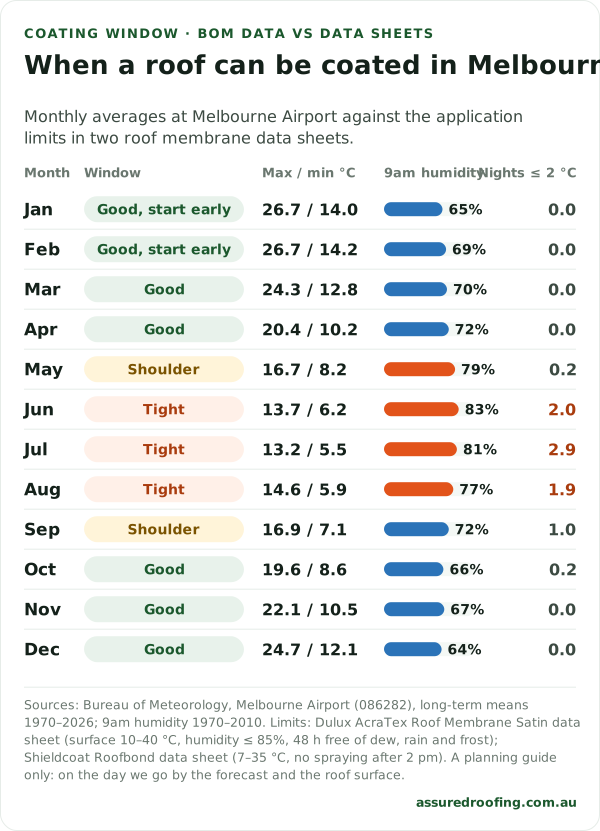
Monthly averages at Melbourne Airport against the application limits in two roof membrane data sheets. The same figures are in the table below.
Month | Coating window | Avg max / min °C | 9am humidity | Nights ≤ 2 °C |
|---|---|---|---|---|
January | Good, start early | 26.7 / 14.0 | 65% | 0.0 |
February | Good, start early | 26.7 / 14.2 | 69% | 0.0 |
March | Good | 24.3 / 12.8 | 70% | 0.0 |
April | Good | 20.4 / 10.2 | 72% | 0.0 |
May | Shoulder | 16.7 / 8.2 | 79% | 0.2 |
June | Tight | 13.7 / 6.2 | 83% | 2.0 |
July | Tight | 13.2 / 5.5 | 81% | 2.9 |
August | Tight | 14.6 / 5.9 | 77% | 1.9 |
September | Shoulder | 16.9 / 7.1 | 72% | 1.0 |
October | Good | 19.6 / 8.6 | 66% | 0.2 |
November | Good | 22.1 / 10.5 | 67% | 0.0 |
December | Good | 24.7 / 12.1 | 64% | 0.0 |
The limits come from the data sheets. Dulux AcraTex Roof Membrane needs a surface between 10 and 40 °C that won't drop below 10 °C while drying, humidity no higher than 85%, and 48 hours free of dew, rain and frost. Shieldcoat Roofbond gives 7 to 35 °C, no spraying after 2 pm and extra curing time in winter.
A full restoration takes us 4 to 5 days on site, so it needs a run of dry days, not just one. That's easy to find in March and hard to find in July.
Good to know winter work is possible on good days, but expect the job to take longer and to move around the forecast.
When do Melbourne’s big storms hit?
Mostly in spring and summer. VICSES says storms cost Victorians $28 million a year on average and bring about 20,000 requests for help a year, around 80% of all its requests.
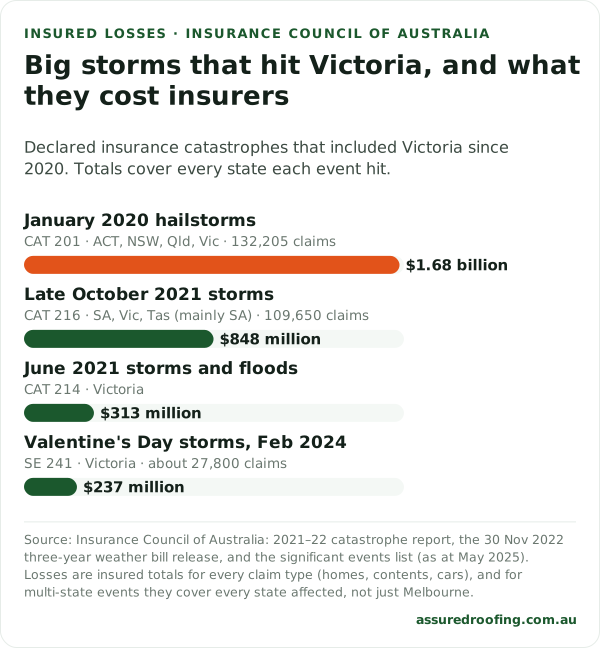
Declared insurance catastrophes that included Victoria since 2020, by insured loss (Insurance Council of Australia). Details are in the table below.
Event | When | States | Insured loss | Claims |
|---|---|---|---|---|
January 2020 hailstorms (CAT 201) | January 2020 | ACT, NSW, Qld, Vic | $1.68 billion | 132,205 |
Late October 2021 storms (CAT 216) | Late October 2021 | SA, Vic, Tas (mainly SA) | $848 million | 109,650 |
June 2021 storms and floods (CAT 214) | June 2021 | Victoria | $313 million | not given |
Valentine's Day storms (SE 241) | February 2024 | Victoria | $237 million | about 27,800 |
On Sunday 19 January 2020, just after 4pm, hail up to 5.5 cm fell on south-east Melbourne. The Australian Disaster Resilience Knowledge Hub lists Glen Iris, Warrandyte, Malvern East and Templestowe among the worst hit, with large hail in Malvern and Camberwell too. If your roof took a hit, here's what to check after hail, and what insurance usually covers.
Your roof checklist, season by season
Season | Check from the ground | Book a roofer for | Best time to book |
|---|---|---|---|
Summer | Roof space heat; gutters clear in bushfire areas; damage after storms | Ventilation, storm repairs | October to November |
Autumn | Gutters and valleys after leaf fall; moss on shaded faces | Restoration or repaint, gutter replacement | February to March |
Winter | Ceiling stains, damp or mould; drips after heavy rain | Leak repairs, repointing | As soon as you spot it |
Spring | Ridge lines and tiles after wind; gutters and downpipes before storms | Repairs before storm season | August to September |
Do not climb onto a wet, windy or storm-damaged roof. Tiles break underfoot and wet metal is slippery. Check from the ground with binoculars, or leave it to a roofer with the right safety gear.
If you'd rather someone looked properly, I do free roof inspections, and I send you photos of what I find. Book one here.
Where you live shifts the calendar
Rain isn't spread evenly across Melbourne. Bureau of Meteorology stations record about 533 mm a year at Laverton in the west, 661 mm at Hawthorn and 845 mm at Glen Waverley.
The further east you go, the more rain days, moss and leaf litter your roof deals with. The full breakdown, suburb by suburb, is in Melbourne rainfall by suburb. Or see what we've found on roofs in Hawthorn and Glen Waverley.
Sources and methodology
Every figure in this guide comes from a published source or from our own work. Here is where each one came from and how we used it.
Where the numbers come from
Bureau of Meteorology, Melbourne Airport (086282): monthly mean rainfall, rain days, temperatures, days at 30 °C and 35 °C or hotter and nights at 2 °C or colder (1970 to 2026); 9am humidity and 3pm wind (1970 to 2010). Checked 19 September 2026.
Bureau of Meteorology, Melbourne (Olympic Park) (086338): monthly rainfall and rain days, 2013 to 2026 (a 13-year record). Checked 19 September 2026.
Cancer Council Australia, UV statistics: average daily maximum UV index for Melbourne by month (ARPANSA data, Gies 2013). Checked 19 September 2026.
Bureau of Meteorology, thunderstorms: most thunderstorms form between September and March and severe storms can happen at any time of year; a storm is severe with hail of 2 cm or more or gusts of 90 km/h or more. Checked 19 September 2026.
VICSES, storms: storm cost ($28 million a year on average), requests for help, and roof tiles as flying debris. Checked 19 September 2026.
VICSES, storm season release (1 October 2025): spring and summer are the high-risk season. Checked 19 September 2026.
Insurance Council of Australia, three-year weather bill (30 November 2022): CAT 201, the January 2020 hailstorms: $1.68 billion from 132,205 claims across the states hit. Checked 20 September 2026.
Insurance Council of Australia, catastrophe report 2021-22: CAT 214 (June 2021) and CAT 216 (October 2021) losses and claims. Checked 19 September 2026.
Insurance Council of Australia, significant events: SE 241, the Valentine's Day storms of February 2024: about 27,800 claims and $237 million (as at May 2025). Checked 20 September 2026.
Australian Disaster Resilience Knowledge Hub: January 2020 hailstorms: time, hail size, SES calls and the worst-hit suburbs. Checked 20 September 2026.
CFA, Fire Danger Period and property preparation guide: when the Fire Danger Period is declared; gutters and roof gaps. Checked 19 September 2026.
Dulux AcraTex Roof Membrane Satin data sheet and Shieldcoat Roofbond data sheet: application temperature, humidity, dew and curing limits. Checked 19 September 2026.
How we worked them out
Monthly figures are the Bureau of Meteorology's published long-term means. We haven't adjusted them. Melbourne Airport is the main station because it has the long record; Olympic Park, in the city, only has 13 years.
"Rain days" are days with at least 1 mm of rain, and "nights at 2 °C or colder" is BOM's mean number of days with a minimum of 2 °C or less.
The coating window compares each month's average maximum, minimum and 9am humidity with the application limits in the two data sheets, then grades the month good, shoulder or tight. It's a planning guide built from averages, not a forecast.
Insured losses are the Insurance Council's figures for declared catastrophes. Where an event hit several states, the total covers all of them, and it includes cars and contents as well as homes.
The roof risk and the job for each month come from our own work on Melbourne roofs, matched to the weather figures.
Good to know averages describe a weather station, not your street, and no single year looks exactly like the average. Suburbs east of the city get a lot more rain than the Airport, so allow for that if you're in the east.
Checked by Ryan Airey on 20 September 2026. Next review: August 2027. How we research, write and check our guides: editorial policy.
Frequently asked questions
What is the best month to restore a roof in Melbourne?
March is the easiest. At Melbourne Airport it averages 24.3 °C by day, 12.8 °C at night and 70% humidity at 9am, well inside roof membrane limits. October to April all work well; on hot summer days we start early. June to August is tight, with cold, damp mornings.
When should I clean my gutters in Melbourne?
For most homes, twice a year: in late autumn once the leaves are down, and in early spring before storm season. Under big trees, clean more often. In bushfire-prone areas the CFA advises keeping gutters clear of leaf litter before and during the warmer months.
What is the wettest month in Melbourne?
November at Melbourne Airport, with an average of 62.4 mm (BOM, 1970 to 2026). In the city, Olympic Park's shorter record (2013 to 2026) puts April first at 66.7 mm, with October and November close behind. August has the most rain days: 9.6 at the Airport.
When is storm season in Melbourne?
Mostly spring and summer. The Bureau of Meteorology says most thunderstorms form between September and March, although severe storms can happen in any month, and VICSES calls spring and summer Victoria's high-risk season for severe thunderstorms, damaging winds and flash flooding.
How often should I get my roof checked?
Check it yourself from the ground twice a year, in autumn and spring, and after any big storm. Get a roofer to look properly if you see cracked mortar on the ridges, slipped tiles, rust or a ceiling stain. My inspections are free, and I send photos of what I find.
Can you paint or restore a roof in winter?
Sometimes, on the right days. Roof membranes need a dry surface of at least 10 °C, humidity no higher than 85% and 48 hours free of dew, rain and frost (Dulux AcraTex data sheet). Melbourne's June to August averages make that tight, so winter jobs take longer and depend on the forecast.
:focal(720x150:1000x430))
)
:focal(720x150:1000x430))
)
)