Hail damage on Melbourne roofs: what breaks, what doesn’t, and what to do
What hail actually does to concrete tiles, terracotta and Colorbond, how big it has to be, how to check your roof from the ground after a storm, and what your insurer will want before any repairs.
:focal(720x150:1000x430))
)
Quick answer: Hail of 2 cm or more makes a storm severe (Bureau of Meteorology), but even pea-sized hail can do damage when it's wind-driven or piles up on a roof. On tiles, look for cracked or broken tiles and ridge caps. On Colorbond, dents are usually cosmetic unless the roof is low-pitched and holds water. After a storm, stay off the roof, photograph what you can see, and talk to your insurer before any repairs.
Most hail in Melbourne is small, and a sound roof shrugs it off. The trouble is the odd big storm, and the damage you can't see from the ground.
Hail is also one of the most common reasons Victorians claim on home insurance. In an AAMI analysis of more than 14,800 weather-related home claims in Victoria (July 2022 to June 2023), rain was the most common cause of damage, then hail, then flood (VICSES and AAMI).
Here's what hail actually does to each type of roof, how to check yours safely, and what to do, in order, after a storm.
How big does hail have to be to damage a roof? 2 cm is the severe mark
The Bureau of Meteorology calls a thunderstorm severe when it brings hail of 2 cm or more (about the size of a $2 coin) or wind gusts of 90 km/h or more. It calls hail of 5 cm or more "very dangerous".
BOM's damage guide says hail under 20 mm damages crops, over 20 mm damages vehicles and over 50 mm causes widespread damage.
Size isn't everything, though. BOM's storm spotters handbook notes that pea- or marble-sized hail can still do extensive damage when wind drives it or it piles up on a roof, and that gusts of about 90 to 100 km/h can lift roof tiles.
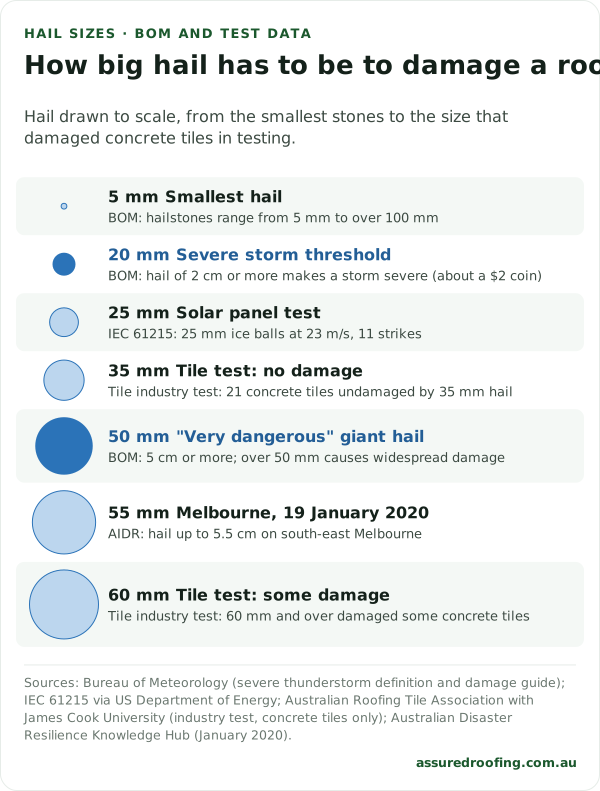
Hail sizes drawn to scale, with what each size means for a roof. The same figures are in the table below.
Hail size | What it means | Source |
|---|---|---|
5 mm | The smallest hail | Bureau of Meteorology |
20 mm (about a $2 coin) | Makes a thunderstorm severe; over 20 mm damages vehicles | Bureau of Meteorology |
25 mm | The ice ball used to hail-test solar panels (IEC 61215) | US Department of Energy |
35 mm | Concrete tiles undamaged in a tile industry test | Australian Roofing Tile Association |
50 mm | "Very dangerous" giant hail; widespread damage | Bureau of Meteorology |
55 mm | The largest hail on south-east Melbourne, 19 January 2020 | AIDR |
60 mm and over | Damaged some concrete tiles in the same industry test | Australian Roofing Tile Association |
What hail does to each type of roof
Sound concrete tiles and Colorbond handle most Melbourne hail. The weak points are old or already-cracked tiles, low-pitched metal roofs where dents can hold water, and the things on top: skylights, solar panels, whirlybirds and gutters.
Roof or part | What to look for | What the evidence says |
|---|---|---|
Concrete tiles | Cracked, broken or slipped tiles and ridge caps | Tile industry test: 21 concrete tiles survived repeated 35 mm hail; some broke at 60 mm and over |
Terracotta tiles | Cracks, chips and broken corners, especially on old or fretting tiles | Not in that test, and the roof tile standard (AS 2049) has no hail or impact test |
Colorbond and metal | Dents and chipped paint; low sections that could hold water | COLORBOND: dents generally don’t shorten roof life and paint loss is mainly cosmetic, except on low-pitched roofs where dents hold water |
Solar panels | Cracked glass | Hail-tested with 25 mm ice at 23 m/s; in a commercial lab test, 61% of standard 2 mm glass panels broke at 45 mm |
Gutters, whirlybirds, skylights | Dents and cracks | Our tip: if these are dented, the hail was big enough to get the roof checked |
That fits what you'd expect on a roof. Sound tiles take most hail, and the ones that crack are usually already weak: fretting, porous, cracked before or walked on. A roof with other problems tends to come off worse.
Good to know the tile test was run by the tile industry, tested concrete tiles only and didn't publish the hail speeds. It's useful, but it isn't the last word, and the Australian roof tile standard doesn't test for hail at all.
If you've got broken tiles, we repair terracotta and concrete tile roofs and restore Colorbond roofs.
How often does big hail hit Melbourne? Rarely: about 0.05 days a year for 30 mm hail
Not often at any one spot, but often enough across the city. A 2024 radar study by University of Queensland and Bureau of Meteorology researchers estimated hail of 30 mm or more at about 0.05 days a year across Victoria and southern South Australia. The authors note it may undercount Melbourne's hail, which tends to be smaller.
Across the country, hail becomes much more common in November, and BOM says most thunderstorms form between September and March.
When it does hit, it's expensive. UNSW researchers found hail caused more than 20% of Australia's insured losses from 1967 to 2023. Their climate modelling put 10 cm hail around Melbourne at about once every 20 years in past simulations, and about once every 3 years in a warmer future. That's a model projection, not a forecast.
The January 2020 hailstorm
On Sunday 19 January 2020, just after 4pm, hail up to 5.5 cm fell on south-east Melbourne. The Australian Disaster Resilience Knowledge Hub lists Glen Iris, Warrandyte, Malvern East and Templestowe among the worst hit, with large hail in Malvern and Camberwell too. VICSES had more than 1,000 calls about building damage by 9pm.
Across the ACT, Victoria and New South Wales, the Insurance Council of Australia puts that month's hail at $1.68 billion from 132,205 claims. By AIDR's earlier count, about 30% of claims came from Victoria.
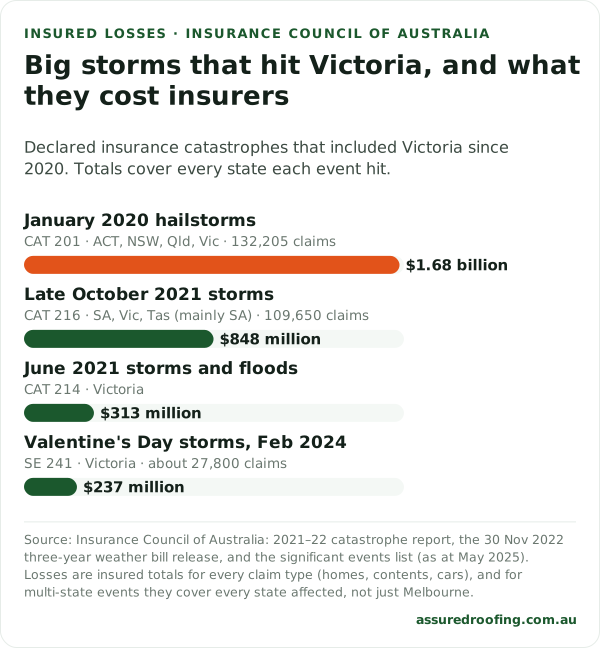
Declared insurance events that included Victoria since 2020, by insured loss (Insurance Council of Australia). Totals cover every state each event hit.
Hail isn't Melbourne's only roof-wrecker. The Valentine's Day storms of February 2024 were mostly fallen trees and power outages, not hail. For every month's risks, see the Melbourne roof maintenance calendar.
What to do after a hailstorm, in order
Stay safe. Stay inside until the storm passes and don't climb onto the roof. Wet tiles and metal are slippery, and cracked tiles break underfoot.
Call VICSES if it’s serious. If the roof is damaged or water is pouring in, call VICSES on 132 500. Call 000 if anyone's life is at risk. VICSES says minor leaks and superficial damage are a job for a tradesperson.
Photograph everything first. Before you clean up, take photos or video of the roof from the ground, the ceilings and anything damaged inside (Insurance Council). A hailstone next to a coin shows its size.
Call your insurer. Tell them about the roof damage as soon as you can, and get their permission in writing before any repairs, including emergency ones. Moneysmart notes insurers can arrange temporary repairs such as roof tarps.
Keep the evidence. Keep damaged items and small samples, and don't throw out anything that could be repaired.
Get the roof inspected. I do free roof inspections and send you photos of what I find. We don't deal with insurers directly, but the photos are yours to send to your insurer.
After a storm VICSES says don't go into a damaged building until you're told it's safe, and stay 8 to 10 metres from fallen powerlines.
How to check your roof for hail damage from the ground
Look along the roof with binoculars for cracked, chipped or missing tiles and broken ridge caps.
Check the gutters and the ground for pieces of tile.
Look for dents in gutters, downpipes, whirlybirds and flashings. If they’re dented, the hail was big enough to check the roof.
On a metal roof, look for dents on low-pitched sections that could hold water.
Check solar panels for cracked glass.
After the next rain, check ceilings and the roof space (from the manhole) for new stains or drips.
Call someone when you can see broken tiles, water is coming in, or a ceiling stain appears after the next rain. Here's how to fix a leaking roof and what a leak usually looks like.
What your insurer will want
Every policy is different, so read yours, but the Insurance Council's advice is consistent: tell your insurer about the roof damage early, photograph it before cleaning up, and get written permission before any building work.
Under the insurance Code of Practice, your insurer should respond within 10 business days, update you at least every 20 business days and decide within 4 months, with some exceptions (Moneysmart). A declined claim must be in writing with reasons, and you can ask for the reports it relied on.
The catch the Insurance Council says a lack of maintenance can reduce a payout or lead to a claim being denied. Old cracked pointing or a rusted valley can make a hail claim harder. More on what home insurance covers.
If you can't resolve a dispute with your insurer, the Australian Financial Complaints Authority is free on 1800 931 678.
Watch out for storm chasers after hail
Consumer Affairs Victoria warns about fake tradies who turn up after storms offering cheap roof repairs, asking for cash up front or offering to drive you to an ATM. You can report them on 1300 133 408.
Door-to-door traders can only call between 9am and 6pm on weekdays and 9am and 5pm on Saturdays, not on Sundays or public holidays unless you've agreed to an appointment. For agreements over $100 you get a 10-business-day cooling-off period, and during it they can't take payment or start work.
The Insurance Council adds that insurers won't send a tradesperson to your door without telling you first.
Tip a genuine local roofer gives you a written quote, has an address and reviews you can check, and won't push you to sign on the doorstep.
Sources and methodology
Every figure in this guide comes from a published source or from our own work. Here is where each one came from and how we used it.
Where the numbers come from
Bureau of Meteorology, thunderstorms: severe storm definition (hail of 2 cm or more, gusts of 90 km/h or more), very dangerous hail (5 cm or more), the damage guide by hail size and the September to March season. Checked 20 September 2026.
Bureau of Meteorology, storm spotters handbook: small hail driven by wind or piled on roofs; gusts of 90 to 100 km/h lifting roof tiles. Checked 20 September 2026.
Brook and others, Monthly Weather Review (2024): radar-based hail frequency in Australia. Checked 20 September 2026.
UNSW newsroom (July 2025): hail share of insured losses, 1967 to 2023, and modelled future hail around Melbourne. Checked 20 September 2026.
Australian Disaster Resilience Knowledge Hub: the 19 January 2020 hailstorm: time, hail size, worst-hit suburbs, VICSES calls and the early claims count. Checked 20 September 2026.
Insurance Council of Australia, three-year weather bill (30 November 2022): January 2020 hail: $1.68 billion from 132,205 claims. Checked 20 September 2026.
Insurance Council of Australia, storm guidance, disaster FAQ and disaster chasers: what to do after storm damage, maintenance and claims, and door-knocking tradespeople. Checked 20 September 2026.
Moneysmart (ASIC): claim timeframes under the insurance Code of Practice, declined claims and temporary repairs. Checked 20 September 2026.
VICSES: when to call 132 500, and safety after a storm. Checked 20 September 2026.
Consumer Affairs Victoria: fake tradies and door-to-door sales rules. Checked 20 September 2026.
COLORBOND FAQ: hail dents and roof life. Checked 20 September 2026.
Australian Roofing Tile Association: hail test on concrete tiles and metal sheets, with James Cook University. Checked 20 September 2026.
Intertek Inform, AS 2049-2002 Roof tiles: the standard’s listed test methods. Checked 20 September 2026.
US Department of Energy and Kiwa PVEL: solar panel hail testing (IEC 61215) and the 2026 hail scorecard. Checked 20 September 2026.
VICSES and AAMI (15 November 2023): most common causes of weather-related home claims in Victoria. Checked 20 September 2026.
How we worked them out
We used each source's figures as published. Hail sizes are diameters.
The hail-size chart puts the published thresholds and test sizes on one scale. The circles are drawn to scale.
The "what to look for" column and the tips come from our own work repairing hail-damaged and weathered roofs in Melbourne.
How the studies we cite were done
Tile hail test: run by the Australian Roofing Tile Association (a tile industry body) with James Cook University. Twenty-one concrete tiles were hit repeatedly with 35 mm hail at various speeds and spots, along with metal sheets. The speeds weren't published and no terracotta tiles were tested.
Radar hail study: University of Queensland and Bureau of Meteorology researchers, Monthly Weather Review, 2024. They used a radar estimate of hail size (MESH) at a 30 mm threshold from 50 radars, 2000 to 2022. The authors say it may undercount the smaller hail common around Melbourne.
UNSW hail study (Raupach and others, 2025): climate modelling, summarised in a UNSW release. It projects rather than measures, and we have read the release, not the full paper.
AAMI claims analysis: one insurer's weather-related home claims in Victoria, July 2022 to June 2023, published in a joint AAMI and VICSES release.
Kiwa PVEL scorecard: a commercial test lab's 2026 results for about 350 solar panels hit with 35 to 55 mm ice balls.
Good to know hail is patchy. Streets a few kilometres apart can get very different storms, and a figure like 0.05 days a year describes a region, not your roof.
Checked by Ryan Airey on 20 September 2026. Next review: September 2027. How we research, write and check our guides: editorial policy.
Frequently asked questions
Does hail damage roof tiles?
Large hail can. In a tile industry test, concrete tiles survived repeated 35 mm hail and some broke at 60 mm and over. Tiles that are already cracked, fretting or porous break more easily, and smaller hail can still do damage when it's wind-driven or piles up on the roof.
Is hail damage on a Colorbond roof a problem?
Usually not structurally. COLORBOND says hail dents generally don't shorten a roof's life and lost paint is mainly cosmetic. The exception is a low-pitched roof, where dents can hold water and dirt and lead to corrosion.
What size hail damages a roof?
The Bureau of Meteorology calls hail of 2 cm or more severe and 5 cm or more very dangerous, and says hail over 50 mm causes widespread damage. Smaller hail can still do damage when strong wind drives it.
Should I call the SES after a hailstorm?
Call VICSES on 132 500 if your roof is damaged or leaking significantly, or 000 if anyone's life is at risk. For minor leaks or superficial damage, VICSES says to call a tradesperson.
Does home insurance cover hail damage to a roof?
Storm and hail damage is commonly covered, but policies differ, so check yours. The Insurance Council says a lack of maintenance can reduce a payout or lead to a claim being denied. Photograph the damage and tell your insurer before any repairs.
Can I get my roof fixed before the insurer assesses it?
Talk to your insurer first. The Insurance Council says to get their permission in writing before any building work, including emergency repairs, and Moneysmart says insurers can arrange temporary repairs such as roof tarps.
:focal(720x150:1000x430))
)
:focal(720x150:1000x430))
)
)