Do whirlybirds work? A Melbourne roofer’s honest answer (and how many you need)
What whirlybirds really do in a Melbourne roof space in summer and winter, how many a house needs, what the building code now says about roof ventilation, and when they won't help.
:focal(720x150:1000x430))
)
Quick answer: Yes, but less than the sales pitch. A whirlybird lets hot air out of a Melbourne roof space in summer and damp air out in winter, which helps with condensation. One US research review found roof-space ventilation saves 5% or less of cooling energy in an insulated home, and a whirlybird only works properly with air coming in low, at the eaves. Most houses need one or two, fitted near the ridge and flashed properly.
Whirlybirds are one of those things everyone has an opinion on. Your neighbour swears by his, and a forum says they're useless.
I fit roof ventilators and whirlybirds, so you'd expect me to say they're great. The honest answer is that they help, in the right roof, for the right reasons, and they don't do what some of the marketing claims.
Here's what the evidence says, what the building code now requires, how many you need, and when one won't help.
What does a whirlybird actually do?
A whirlybird is a wind-driven extractor. Wind spins the turbine, which draws air out of the roof space, and fresh air comes in lower down, usually through the eaves.
The Australian Government's YourHome guide says a well-ventilated roof space acts as a buffer at the roof, and that whirlybirds and similar ventilators can reduce the temperature difference across your ceiling insulation, which makes the insulation work better. Even with no breeze, some heat still rises out through the vent.
Good to know a whirlybird ventilates the roof space, not your rooms. Your ceiling insulation is still the thing keeping heat out of the house.
A Melbourne roof space has two problems: summer heat and winter damp
In summer, heat builds up under the roof. Melbourne Airport averages 8.8 days at 30 °C or hotter in January and 3.8 at 35 °C or hotter (BOM). On a January day in 2011, University of Melbourne researchers measured a bare metal roof at 68 °C. A lighter roof colour cuts that heat at the source; I've looked at whether heat-reflective roof paint is worth it.
In winter, the problem flips to moisture. June averages 83% humidity at 9am, and cold roof timbers turn damp air into condensation. YourHome notes condensation can form under any roofing material, in any season and in every climate zone, and that a fully vented roof space can fix it.
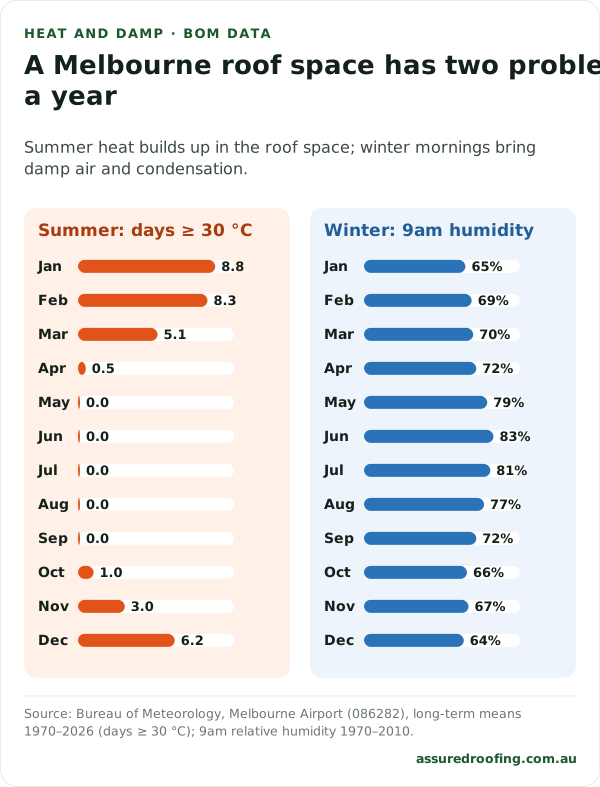
Days at 30 °C or hotter and 9am humidity by month at Melbourne Airport (BOM). The same figures are in the table below.
Month | Days ≥ 30 °C | 9am humidity | What the roof space is doing |
|---|---|---|---|
January | 8.8 | 65% | Heat building up |
February | 8.3 | 69% | Heat building up |
March | 5.1 | 70% | Mild |
April | 0.5 | 72% | Mild |
May | 0.0 | 79% | Damp; condensation risk |
June | 0.0 | 83% | Damp; condensation risk |
July | 0.0 | 81% | Damp; condensation risk |
August | 0.0 | 77% | Damp; condensation risk |
September | 0.0 | 72% | Mild |
October | 1.0 | 66% | Mild |
November | 3.0 | 67% | Mild |
December | 6.2 | 64% | Heat building up |
Do whirlybirds cut power bills? The evidence says only a little
A literature review by the Florida Solar Energy Center found roof-space ventilation cuts cooling energy by 5% or less in homes with normal ceiling insulation. In a 1979 side-by-side house test it reports, turbine or ridge vents cut the heat coming through the ceiling by about 19%, but that was no more than 3% of the whole house's peak cooling load.
The same review found powered roof fans used more electricity than they saved.
The Australian data is thin. A University of Technology Sydney lab test done for CHOICE found a plain open pipe moved more air than the turbines it tested, and that single-number ratings are too simple to describe a vent. I couldn't find a CSIRO, government or university field study measuring what whirlybirds do to Melbourne roof temperatures.
The catch if someone quotes you a precise temperature drop or bill saving for a whirlybird, ask where it came from. The published research doesn't support big numbers for an insulated home.
Study | What it measured | What it found |
|---|---|---|
Published studies of roof-space ventilation | Cooling energy down 5% or less in insulated homes; powered fans used more power than they saved | |
Texas side-by-side houses (1979, via FSEC) | Heat flow through the ceiling | Down about 19%, but no more than 3% of peak cooling load |
Airflow of vents on a lab rig | An open pipe beat the turbines; single ratings are too simple |
What the building code now says about roof ventilation
Since the 2022 National Construction Code, new homes in climate zones 6, 7 and 8 need a ventilated roof space (ABCB Housing Provisions 10.8.3). Every metropolitan Melbourne council is climate zone 6, and the rule took effect in Victoria on 1 May 2024.
The roof space has to be at least 20 mm high, with openings spread evenly low and high. An unsarked tiled roof already complies, because air moves through the gaps between the tiles.
Roof pitch | Minimum ventilation openings (per metre of the roof’s longest side) |
|---|---|
under 10° | 25,000 mm² per metre at each of two opposite ends |
10° to under 15° | 25,000 mm² per metre at the eaves plus 5,000 mm² per metre high up |
15° to under 75° | 7,000 mm² per metre at the eaves plus 5,000 mm² per metre high up (plus 18,000 mm² per metre at the eaves for a cathedral ceiling) |
"High up" means at the ridge or no more than 900 mm below it. Under the old code, NCC 2019, roof ventilation was only required where an exhaust fan emptied into the roof space; now bathroom and kitchen exhausts have to vent outside.
Good to know the code applies to new building work, not to homes that already exist. But it tells you where the thinking has gone: a Melbourne roof space should breathe.
How many whirlybirds do I need? Usually one or two
For most Melbourne houses, one or two. Bradford's rule of thumb is one roof vent per 90 m² of roof, with four eave vents for each one (manufacturer guidance), and a distributor FAQ says most houses need two.
Roof area | Whirlybirds (1 per 90 m²) | Eave vents (4 per whirlybird) |
|---|---|---|
Up to 90 m² | 1 | 4 |
90 to 180 m² | 2 | 8 |
180 to 270 m² | 3 | 12 |
You can also work it from the code. On a 15 m long roof at a normal pitch, the NCC's high-level figure is 15 × 5,000 mm², or 75,000 mm², a little more than the 62,500 mm² throat of one large whirlybird (Bradford WindMaster). In practice that means two. The eaves need 105,000 mm² of openings as well.
Tip the air has to come in somewhere. Lysaght's guidance for low-pitched metal roofs is about twice as much opening low down as high up. A whirlybird on a roof with sealed eaves just spins.
When a whirlybird won’t help, or makes things worse
No air coming in. Without eave or other low vents, the turbine has nothing to replace the air it pulls out.
A leaky ceiling. YourHome says air leaks can cause 15 to 25% of a home's winter heat loss, and that the ceiling should be sealed against draughts. A vent pulling on a leaky ceiling pulls warm air out of your rooms.
Exhaust fans venting into the roof. Bathroom and kitchen fans should vent outside, not into the roof space, where they add moisture.
Poor flashing. Bradford's installation instructions put a tile-roof vent at the third or fourth row below the ridge, because lower positions reduce performance and raise the risk of leaks in heavy rain, with no gaps over 3 mm.
Powered fans. The FSEC review found powered roof fans used more electricity than they saved.
Whirlybirds in bushfire areas
Embers can travel more than a kilometre ahead of a fire. The VBA and CFA retrofit guide says roof ventilators need ember guards with a maximum 2 mm aperture, in corrosion-resistant steel, bronze or aluminium, and gaps sealed to 3 mm or less. A manufacturer figure puts the airflow lost to a spark guard at about 30%, so you may need an extra vent.
Getting a whirlybird fitted
We install roof ventilators and whirlybirds, set in the right row and flashed properly so they don't leak. On a metal roof, the manufacturer's instructions put the vent at the ridge cap.
Before you buy one, I'll look at your roof space, your eaves and your ceiling insulation, and tell you honestly whether ventilation will make a difference. If it's also time to look after the rest of the roof, a roof restoration is a good time to add one. Ask for a free quote, or see what our weather does to your roof in the Melbourne roof maintenance calendar.
Sources and methodology
Every figure in this guide comes from a published source or from our own work. Here is where each one came from and how we used it.
Where the numbers come from
ABCB, NCC 2022 Housing Provisions Part 10.8: roof-space ventilation for climate zones 6 to 8 (10.8.3), the openings table and exemptions. Checked 20 September 2026.
ABCB, NCC 2022 Volume Two Part H4: performance requirement H4P7 and how Part 10.8 satisfies it. Checked 20 September 2026.
ABCB, Victoria climate zone map: metropolitan Melbourne is climate zone 6. Checked 20 September 2026.
ABCB, NCC 2019 Part 3.8.7: the earlier roof ventilation rule. Checked 20 September 2026.
YourHome (Australian Government): passive cooling, ventilation and airtightness, condensation: roof-space ventilation, whirlybirds and insulation, winter air leaks and condensation. Checked 20 September 2026.
Bureau of Meteorology, Melbourne Airport (086282): days at 30 °C and 35 °C or hotter (1970 to 2026) and 9am humidity (1970 to 2010). Checked 19 September 2026.
Florida Solar Energy Center, FSEC-CR-1496-05: review of roof-space ventilation and cooling energy. Checked 20 September 2026.
Revel and Huynh (UTS), Characterising Roof Ventilators: lab test of roof ventilator airflow for CHOICE. Checked 20 September 2026.
University of Melbourne for the City of Melbourne, Cool Roofs (2011): measured roof surface temperatures in January. Checked 20 September 2026.
Bradford (CSR): WindMaster and installation instructions: vent sizing rule of thumb, throat area and installation position (manufacturer claims). Checked 20 September 2026.
Lysaght PAB21 roof ventilation bulletin: ratio of low to high openings on low-pitched metal roofs. Checked 20 September 2026.
VBA and CFA, retrofit guide for bushfire protection (2014): ember guards on roof vents. Checked 20 September 2026.
How we worked them out
We used each source's figures as published. Manufacturer and distributor figures are labelled as such; they're claims, not independent tests.
The "how many" table applies Bradford's one-vent-per-90 m² rule. The 15 m example multiplies the NCC's per-metre figures by the roof's length and compares the result with the WindMaster's published throat area. It illustrates the scale, it isn't a compliance design.
YourHome pages were read from web archive snapshots dated December 2025 to September 2026, because the live site didn't respond when we checked.
How the studies we cite were done
FSEC review: Parker, Florida Solar Energy Center, 2005, a review of published studies for the Florida government. The climate is hot and humid and the houses are older US homes, so treat it as a rough guide for Melbourne.
Texas test (Burch and Treado, 1979): two instrumented side-by-side houses, as reported in the FSEC review; we haven't read the original.
UTS test: Revel and Huynh, 2004, for CHOICE. A 250 mm turbine, a 300 mm turbine, a 300 mm venturi and an open 300 mm pipe were each fitted to a 1.2 × 1.2 × 2.4 m test box, with fan-made wind of 8 to 25 km/h. It measured airflow only, not roof temperatures or energy, and brands weren't named.
Good to know no independent study has measured whirlybirds on Melbourne houses, so the benefit for your home depends on your roof space, your insulation and your eaves.
Checked by Ryan Airey on 20 September 2026. Next review: October 2027. How we research, write and check our guides: editorial policy.
Frequently asked questions
Do whirlybirds work in winter?
Yes. They keep pulling damp air out of the roof space, which helps prevent condensation, and YourHome notes a fully vented roof space can fix condensation build-up. They also let some warmth out of the roof space, which matters little if your ceiling is insulated and sealed.
How many whirlybirds do I need?
Most houses need one or two. Bradford's rule of thumb is one per 90 m² of roof with four eave vents for each, and the air has to come in low as well as go out high.
Do whirlybirds cause roof leaks?
Not when they're fitted properly. Bradford's instructions put a tile-roof vent at the third or fourth row below the ridge, because lower positions raise the risk of leaks in heavy rain, and allow no gaps over 3 mm.
Are powered or solar roof fans better than whirlybirds?
Not necessarily. A Florida Solar Energy Center review found powered roof fans used more electricity than they saved. A solar fan avoids the power bill, but like a whirlybird it still needs low vents to work.
Does a new house in Melbourne need roof ventilation?
Yes. Under the NCC 2022, new homes in climate zones 6 to 8, which covers all of metropolitan Melbourne, need a ventilated roof space, from 1 May 2024 in Victoria. Whirlybirds, ridge vents or other openings can do it, and an unsarked tiled roof complies as it is.
Do whirlybirds need ember guards?
In bushfire-prone areas, yes. The VBA and CFA retrofit guide says roof vents need ember guards with a maximum 2 mm aperture, and a manufacturer figure puts the airflow lost to a spark guard at about 30%.
:focal(720x150:1000x430))
)
:focal(720x150:1000x430))
)
)