How much does roof painting cost in Melbourne? (2026 guide)
What roof painting really costs in Melbourne in 2026, the price per square metre, why a proper job is closer to a restoration than a coat of paint, and how to avoid a job that peels in two winters.

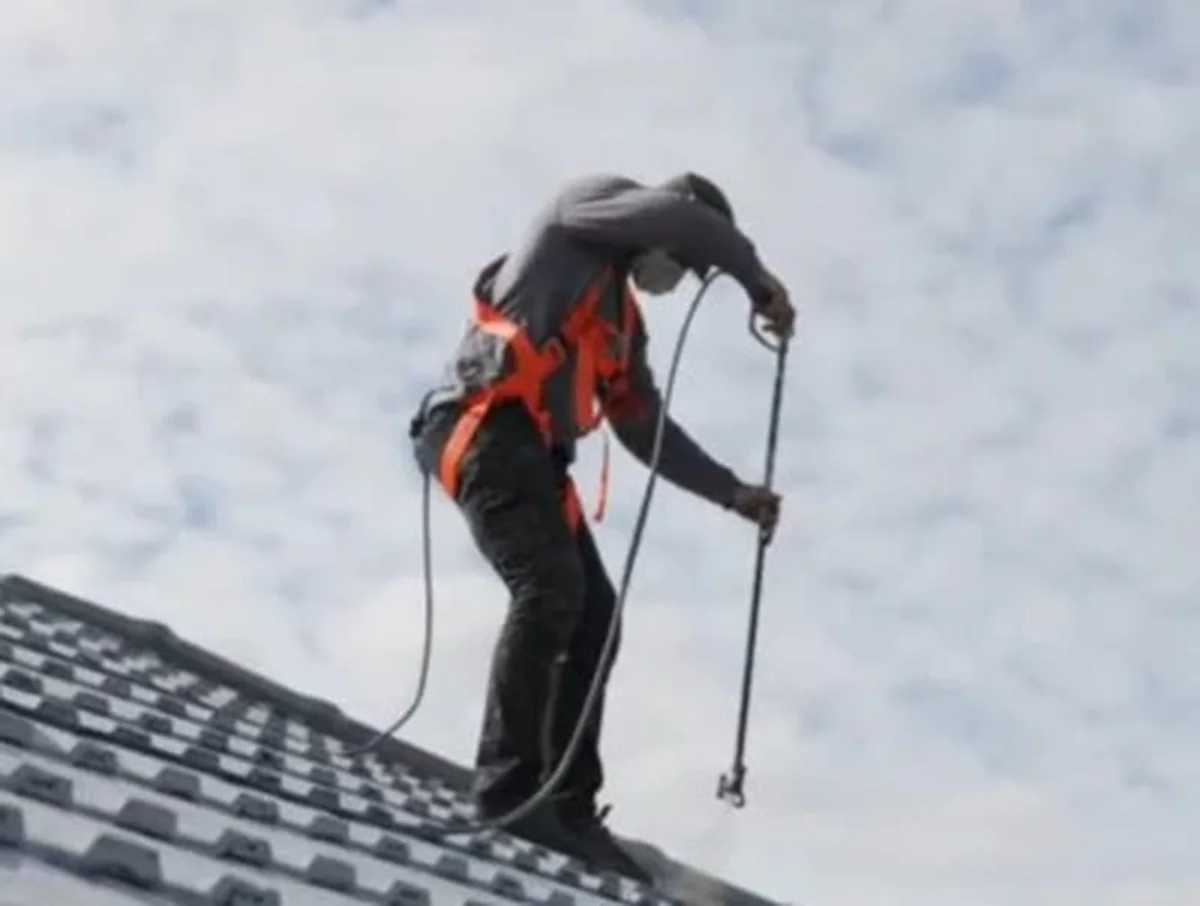
Quick answer: a proper roof painting job in Melbourne costs about $2,500 to $6,000 in 2026, or roughly $18 to $35 per square metre. But "roof painting" done right is really a restoration: cleaning, repairs, primer and two to three coats, and that is where the price and the 12-to-15-year lifespan come from. A cheap paint-only job under $2,000 will peel within a couple of winters.
People ring me asking for a price to "just paint the roof". I get it, it sounds simple. But the honest truth after 20 years on Melbourne roofs is that the paint is the easy part. What you are really paying for is the prep, and that is what separates a coat that lasts 12 to 15 years from one that flakes off by the next winter. Here are the real numbers and exactly what sits behind them.
Roof painting cost per square metre in Melbourne
Most Melbourne roof painting works out to roughly $18 to $35 per square metre for a proper job, which puts an average single or double-storey home in the $2,500 to $6,000 range. The spread comes down to roof size, pitch, how much repair the roof needs first, and whether it is tile or Colorbond.
Roof | Typical roof painting cost |
|---|---|
Small single-storey tile roof | $2,500 to $3,800 |
Average family home (180 to 220m²) | $3,500 to $5,500 |
Large or double-storey, steep pitch | $5,500 to $8,000+ |
Colorbond / metal re-coat | Quoted per roof after a look |
Those are market ranges for a done-properly job. If you are getting quotes wildly below them, the gap is almost never a better deal, it is missing steps, which is the whole point of the next section.
Painting a roof is not just paint
This is the bit cheap operators skip. Paint will not stick to a dirty, chalky, mossy roof, and it will not seal a roof that has cracked pointing or broken tiles. A roof done properly gets:
A high-pressure clean to strip moss, lichen and old flaking coating (ours is a 3,500 PSI Jetblaster)
Repairs first: re-bed and re-point the ridge caps, replace cracked tiles, sort valleys and flashings
A primer or sealer coat, which is what the colour actually bonds to
Two to three coats of a proper roof membrane, not house paint
That is why a real quote is closer to a full roof restoration than a painting job. If someone quotes you $1,500 to "paint the roof", ask what prep and repairs are included. Usually the answer is none, and that coat is coming off.
What paint (really, coating) is used
We use proper roof membranes like Globalcoat and Shieldcoat, rolled or sprayed over a Dulux AcraTex style primer system. These are built for a roof: UV stable, flexible so they move with the tiles, and made to shed Melbourne rain. Standard house or fence paint has no place on a roof; it is not made to flex or handle that much water and sun, and it fails fast.
Painting vs restoration: are they the same thing?
In practice, a good "roof painting" job and a "roof restoration" are the same job with different names, and this is where dodgy pricing hides. A restoration is understood to include the repairs, re-pointing, clean, primer and coats. "Painting" is sometimes sold as just the colour coats. So when you compare a $1,800 paint quote against a $5,000 restoration quote, you are usually not comparing the same work at all. I break down the full roof restoration cost separately, and the honest read is that the number that matters is what is included, not the word on the quote.
What changes the price
Roof size and number of storeys (the biggest factor)
Pitch: steeper roofs are slower and need more safety gear
Condition: lots of cracked tiles or rusted valleys add repair cost before any coating
Tile or Colorbond: metal needs rust treatment and a metal primer
Colour changes: going much lighter or darker than the current colour can need an extra coat for coverage
Do you need a permit to paint your roof in Melbourne?
For a straight recoat in a similar colour, generally no. The exception worth checking is if your home is in a heritage overlay, where councils can have a say on roof colour and finish. If you are in a period pocket of somewhere like Kew or another heritage street, a quick call to your council before you commit to a dramatic colour change saves grief later. For a like-for-like restoration it is almost never an issue.
Is roof painting worth it, or should you restore or replace?
If your roof is structurally sound and it is really the colour and coating that have gone, then a proper paint job (a restoration) is excellent value: it adds years of life and lifts the whole look of the house for a fraction of a re-roof. If the tiles are cracking across the roof or terracotta is fretting, no amount of paint fixes that, and you are looking at a roof replacement instead. I have written an honest take on whether restoration is worth it that covers where the line sits.
When is the best time of year to paint a roof in Melbourne?
Coatings need dry conditions to cure between coats, so the stretch from late spring through summer to early autumn is ideal. That does not mean winter work is impossible, a good roofer works around the weather and the forecast, but you want dry days back to back for the coating stage, which is easier to line up in the warmer months. Booking in late winter for an early spring slot is smart, because the good crews fill up once the weather turns.
Here's how that looks month by month. Dulux AcraTex Roof Membrane needs a surface between 10 and 40 °C, humidity no higher than 85% and 48 hours free of dew, rain and frost; Shieldcoat Roofbond gives 7 to 35 °C and no spraying after 2 pm.
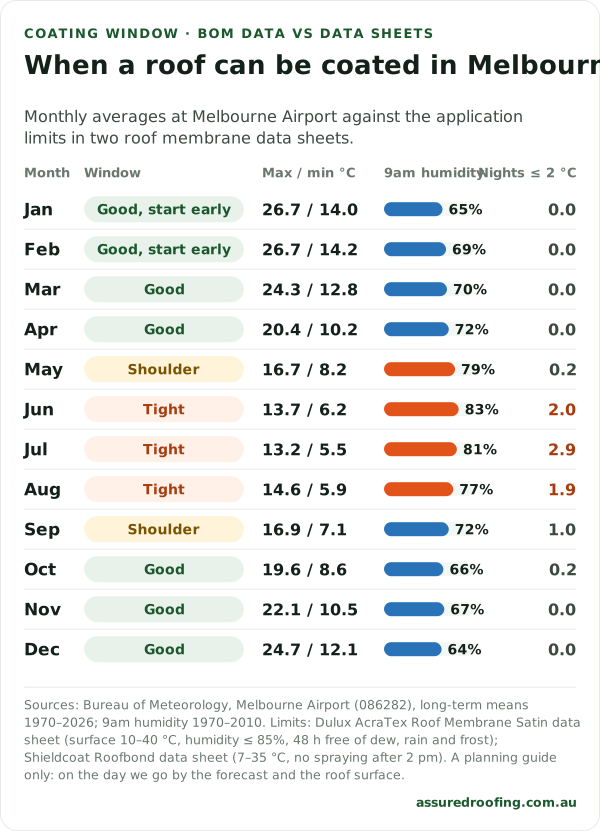
When a roof can be coated: Melbourne Airport averages against two roof membrane data sheets. The month-by-month figures are in the table below.
Month | Coating window | Avg max / min °C | 9am humidity |
|---|---|---|---|
January | Good, start early | 26.7 / 14.0 | 65% |
February | Good, start early | 26.7 / 14.2 | 69% |
March | Good | 24.3 / 12.8 | 70% |
April | Good | 20.4 / 10.2 | 72% |
May | Shoulder | 16.7 / 8.2 | 79% |
June | Tight | 13.7 / 6.2 | 83% |
July | Tight | 13.2 / 5.5 | 81% |
August | Tight | 14.6 / 5.9 | 77% |
September | Shoulder | 16.9 / 7.1 | 72% |
October | Good | 19.6 / 8.6 | 66% |
November | Good | 22.1 / 10.5 | 67% |
December | Good | 24.7 / 12.1 | 64% |
Spray or roll, and how many coats?
Two questions worth asking any quoter. Most roof coating is sprayed, which is fast and gives an even finish, and a good operator back-rolls the first coat on tile to work it into the surface for a better bond. The number of coats matters more than the method: you want a primer or sealer plus two to three colour coats, not a single thick coat that looks fine wet and chalks off in a couple of years. If a quote says "two coats" without a primer, that is a warning sign; the primer is what the whole system grips to. Ask how many litres are going on your roof area, because a coating spread too thin to hit its coverage rate simply will not last, whatever the tin promises.
What a proper painting quote should itemise
A quote you can trust reads like a scope of works, not a single number. Before you sign anything, make sure it spells out:
The clean: high-pressure wash to strip moss, lichen and old coating
The repairs: how many tiles replaced, how many metres of ridge re-pointed or re-bedded
The primer or sealer, named, and the coating system, named (Globalcoat, Shieldcoat or similar)
The number of colour coats (two to three) and the colour
The guarantee in writing: product guarantee and workmanship warranty, with the years stated
When three quotes all list this, you can compare them fairly. When one is half the price and lists none of it, you have found the difference. That cheap number is not a better deal on the same job, it is a different, lesser job wearing the same word.
Getting an honest quote
Get a roofer up on the roof, not just a price over the phone. A real quote lists the clean, the repairs, the primer and the number of coats, so you can compare like for like. Ours is free and itemised. If you want to see the finish, browse our recent Melbourne jobs, or book a free quote.
Sources and methodology
Every figure in this guide comes from a published source or from our own work. Here is where each one came from and how we used it.
Where the numbers come from
Dulux AcraTex Roof Membrane Satin data sheet: surface 10 to 40 °C, humidity no higher than 85%, 48 hours free of dew, rain and frost. Checked 19 September 2026.
Shieldcoat Roofbond data sheet: 7 to 35 °C, no spraying after 2 pm, extra curing time in winter. Checked 19 September 2026.
Bureau of Meteorology, Melbourne Airport (086282): monthly means: rainfall, rain days, temperatures and cold nights (1970 to 2026); 9am humidity and 3pm wind (1970 to 2010). Checked 19 September 2026.
Dulux AcraTex: linked in this guide.
How we worked them out
Weather figures are the Bureau of Meteorology's published long-term means. We haven't adjusted them, and BOM updates them as each year is added, so we re-check them at every review.
Prices in this guide are indicative Melbourne market ranges, not quotes. We price every job free after looking at the roof.
The coating window compares each month's averages with the two data sheets' limits. It's a planning guide, not a forecast.
The roof advice and what we see on jobs come from our own work on Melbourne roofs.
Good to know averages describe a weather station, not your street, and no single year looks exactly like the average.
Checked by Ryan Airey on 20 September 2026. Next review: August 2027. How we research, write and check our guides: editorial policy.
Frequently asked questions
How much does it cost to paint a roof per square metre?
In Melbourne, roughly $18 to $35 per square metre for a proper job that includes cleaning, repairs, primer and coats. Paint-only jobs are cheaper up front but do not last, so they cost more over time.
Is roof painting just a coat of paint?
No, not if it is done properly. A lasting job is really a restoration: a pressure clean, re-pointing and repairs, a primer, then two to three coats of roof membrane. The prep is what makes it last 12 to 15 years instead of two.
How long does roof painting last?
A properly prepped and coated roof lasts 12 to 15 years, backed by our 10-year product guarantee. A cheap paint-only job over a dirty roof can start peeling within a couple of Melbourne winters.
Can I paint my own roof?
You can, but the two hard parts are safety (working at height on a pitched roof) and prep (cleaning, repairs and priming). Most DIY roof paint jobs fail on the prep, not the paint. For most people it is not worth the risk or the redo.
Can you paint a Colorbond roof?
Yes. A faded or chalky Colorbond roof is pressure washed, rust treated, primed with a metal primer and finished with colour membrane. See our Colorbond roof restorations for how that works.
Do you need a permit to paint a roof in Melbourne?
For a normal recoat, generally no. If your home is in a heritage overlay, the council may have a say on roof colour, so it is worth a quick check before a dramatic colour change. A like-for-like restoration is rarely an issue.